

ENTUAL BLOG
On this page, we would like to share some engaging articles with you on everything related to data integration with Ab Initio, ETL development, data warehouse development, or simply interesting programming topics we’re currently exploring.
If you have any questions, comments, or ideas regarding these topics, please feel free to contact us!
Anyone coming from the Ab Initio world is used to having complete control over the data pipeline from the very beginning. In Spark, this feels a bit different at first: you write code and perform transformations and actions, but the optimizer decides in the background how the code is actually executed. To make this more tangible, let’s look at a concrete example: From graph to plan - understanding what happens under the hood!
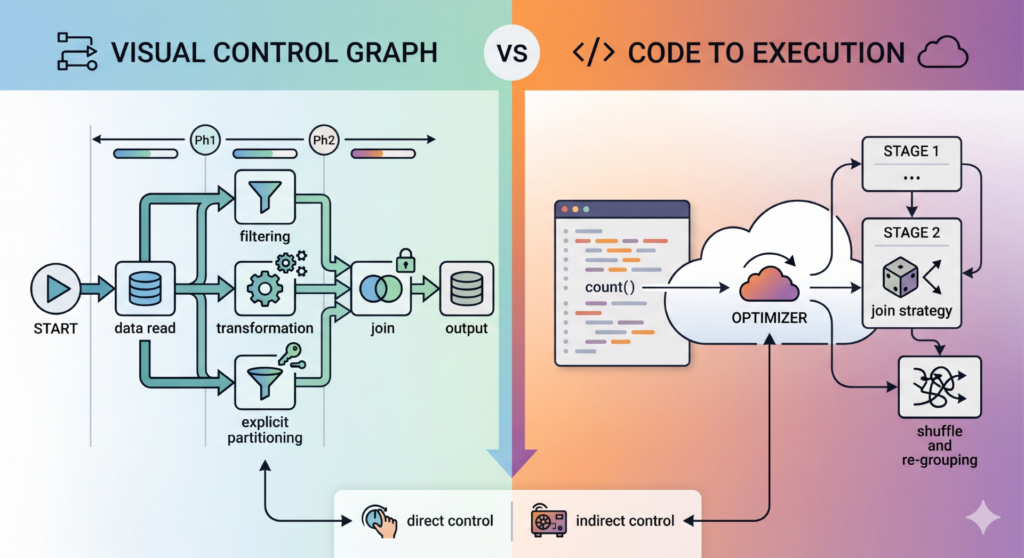
Visualization created with the help of AI (Gemini)
In this introduction, we’ll show you how to combine the proven stability and seamless data lineage of the enterprise world with cloud-native speed to implement robust, future-proof data architectures using Databricks and dbt in record time.
Now that we’ve examined the strategic and architectural foundations of a future-proof cloud data platform, we’ll take a closer look at the technical implementation of the first and most important step: data ingestion.
Raw data alone does not create business value. The next logical step is data transformation. In this article, we’ll show you how we use dbt and the Medaillon architecture to transform raw data into valuable business insights.
The technical architecture of a data platform does not end with ingestion and transformation. Different business transformation rules must be encapsulated in jobs, dependencies defined, executions monitored, and errors handled appropriately. Without structured orchestration, a tangled web of isolated jobs, manual triggers, and incorrect dependencies can quickly emerge.
After developing the scripts and dbt models directly within the Databricks interactive environment and testing them against real data, we migrate these artifacts to a professional deployment structure. To do this, we use Databricks Asset Bundles (DABs), a tool that adapts software development best practices for data projects.
In addition to meeting technical requirements, a key indicator of a data platform’s success is, above all, the confidence that business users have in the metrics it provides. In building our cloud data platform with Databricks and dbt, we rely on two key pillars to meet these requirements: automated data quality (DQ) tests and seamless end-to-end lineage.
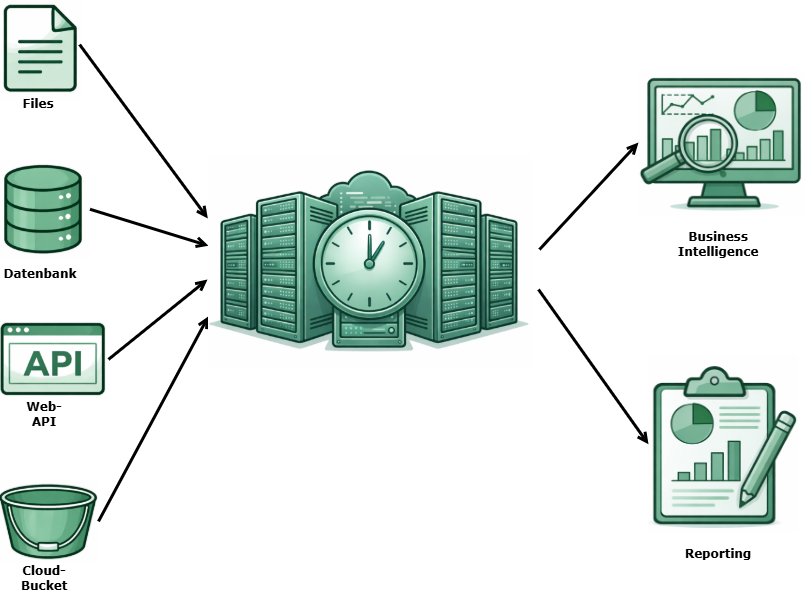
Visualization created with the help of AI (Gemini)
In the first part of our multi-part series, you'll learn the basics of programming a chess computer.
In this second blog post, we’ll explore how a chess computer can calculate all possible moves in a given board position and how a rating function for those moves is implemented.
In the third part, we will discuss the technical aspects of implementation using Ab Initio. The focus will be on implementing a web service graph with Ab Initio, enhanced with chess-specific features.

https://stockfishchess.org/